


The Invisible Chemistry of Productivity
How the Chemical Properties of Soil Determine Crop Health, Nutrient Efficiency and Yield
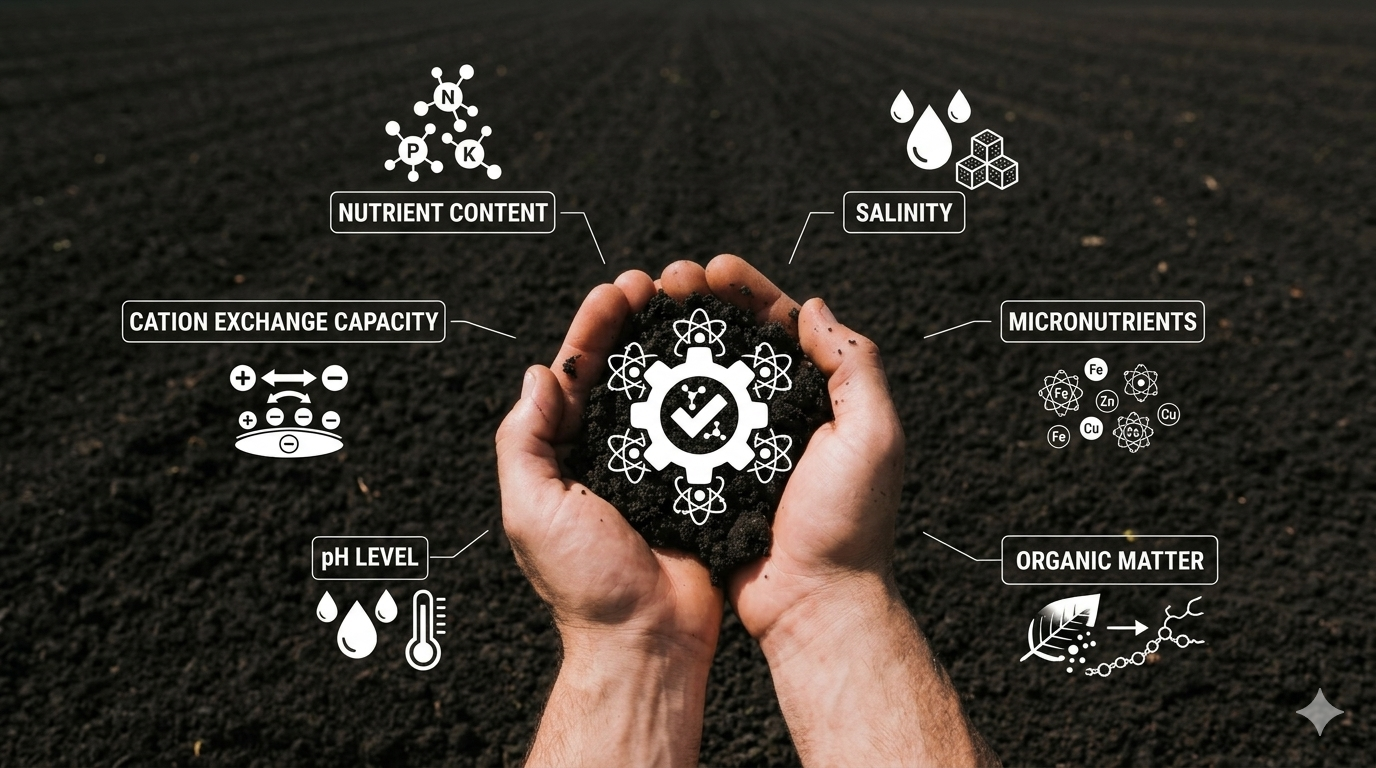
A farmer may see soil as brown earth beneath the feet, but in reality it is a highly active chemical environment that directly determines whether crops flourish or struggle. Inside every handful of soil, complex chemical reactions are constantly taking place controlling nutrient availability, influencing root development and shaping plant growth.
While physical properties create the structure of soil, the chemical properties govern the fertility system that feeds crops. If the chemical balance is disturbed, plants may suffer nutrient deficiencies even when fertilizers are applied in large quantities. Understanding soil chemistry therefore becomes essential for efficient crop production, sustainable farming and long-term soil health.
This article explores the importance of chemical properties of soil and how they influence plant nutrition, crop performance and agricultural productivity.
Soil pH: The Master Regulator of Nutrient Availability
Among all chemical properties, soil pH is the most influential because it controls how nutrients behave in soil. Soil pH measures the acidity or alkalinity of soil on a scale from 0 to 14.
Most agricultural crops grow best within a pH range of about 6.0 to 7.5. Within this range, the majority of essential nutrients remain available for plant uptake. When soil becomes too acidic, nutrients like phosphorus, calcium, and magnesium become less available, while elements such as aluminum and manganese may reach toxic levels. In highly alkaline soils, micronutrients such as iron, zinc, and manganese become locked and unavailable to plants.
The result is a situation where nutrients may be present in the soil but plants cannot access them. Farmers often misinterpret this as nutrient deficiency and apply more fertilizers, increasing costs without solving the underlying problem.
Managing soil pH through organic amendments, balanced fertilization, and proper irrigation practices ensures that nutrients remain accessible to crops throughout the growing cycle.
Nutrient Availability: The Soil’s Fertility Bank
Chemical fertility of soil depends on the presence and availability of essential nutrients required for plant growth. These nutrients are broadly categorized into macronutrients and micronutrients.
Macronutrients such as nitrogen, phosphorus, and potassium are required in larger quantities because they support major plant functions like leaf development, root growth, flowering, and fruit formation. Secondary nutrients like calcium, magnesium, and sulfur play crucial roles in cell structure, photosynthesis, and protein synthesis.
Micronutrients, although required in smaller quantities, are equally important. Elements such as iron, zinc, copper, manganese, and boron participate in enzyme activation, metabolic reactions, and reproductive processes.
The chemical composition of soil determines how these nutrients exist, move, and interact. Nutrients may dissolve in soil solution, bind to clay particles, attach to organic matter, or become fixed in mineral forms. Proper soil chemistry ensures that nutrients remain available in forms plants can absorb through their roots.
Balanced nutrient management, rather than excessive fertilization, is therefore the key to maintaining chemical fertility.
Cation Exchange Capacity: The Soil’s Nutrient Storage System
Cation Exchange Capacity, commonly known as CEC, is the soil’s ability to hold and exchange positively charged nutrient ions. Nutrients such as potassium, calcium, magnesium, and ammonium carry positive charges and are retained on the surfaces of soil particles, particularly clay and organic matter.
Soils with higher CEC can store larger quantities of nutrients and release them gradually to plants. This acts like a nutrient reservoir that prevents rapid leaching and ensures steady nutrient supply throughout crop growth.
Sandy soils generally have lower CEC because of their larger particles and limited surface area. As a result, nutrients may wash away quickly during irrigation or rainfall. Clay-rich soils and soils rich in organic matter typically possess higher CEC and therefore greater nutrient holding capacity.
Improving soil organic matter is one of the most effective ways to increase CEC and enhance the soil’s nutrient retention ability.
Soil Salinity: Managing Salt Stress in Crops
Salinity refers to the accumulation of soluble salts in soil. While small amounts of salts are naturally present in soils, excessive salt concentration can severely affect crop growth.
High salinity interferes with the plant’s ability to absorb water. Even when soil appears moist, plants experience physiological drought because salts create osmotic stress around the roots. This leads to poor germination, stunted growth, leaf burn, and reduced yield.
Salinity problems are common in arid regions, areas with poor drainage, and fields irrigated with saline water. Chemical imbalance caused by excessive salts also affects soil structure and microbial activity.
Proper irrigation management, drainage improvement, organic matter addition, and the use of salt-tolerant crop varieties can help manage salinity and restore soil productivity.
Nutrient Interactions: The Balance That Plants Need
Soil nutrients do not function independently. They interact chemically with one another, influencing their availability and plant uptake.
For example, excessive phosphorus can interfere with the absorption of zinc and iron. High potassium levels may reduce magnesium uptake. Similarly, imbalanced nitrogen fertilization can lead to excessive vegetative growth while weakening plant resistance to stress.
These interactions highlight the importance of balanced soil chemistry. Over-application of a single nutrient may create unintended deficiencies of others. Effective soil fertility management therefore requires understanding the chemical relationships among nutrients.
Regular soil testing and integrated nutrient management practices help maintain the proper balance required for healthy crop growth.
Chemical Reactions in Soil: The Engine of Nutrient Cycling
Soil is not chemically static. Numerous reactions constantly convert nutrients between different forms. Organic materials decompose and release nutrients through mineralization. Some nutrients dissolve into soil solution where they can be absorbed by roots. Others become temporarily fixed within soil minerals and later released again.
These chemical transformations regulate nutrient availability over time. A healthy soil ecosystem maintains a dynamic equilibrium where nutrients are continuously recycled and supplied to crops.
Maintaining this balance requires minimizing chemical disturbances such as excessive synthetic inputs, over-irrigation, or poor soil management practices that disrupt natural nutrient cycles.
Practical Ways to Maintain Healthy Soil Chemistry
Farmers can improve and maintain favorable chemical properties of soil through several practical approaches.
Regular soil testing provides valuable insights into pH levels, nutrient status, and salinity conditions. This allows farmers to apply inputs based on actual crop requirements rather than guesswork.
Increasing organic matter through compost, crop residues, and biological inputs improves nutrient retention, enhances CEC, and buffers soil pH. Balanced fertilization strategies ensure that plants receive the right combination of nutrients rather than excessive quantities of a single element.
Proper irrigation management also prevents nutrient leaching and salt accumulation. By maintaining chemical balance in soil, farmers can achieve more efficient nutrient use and better crop productivity.
Why Soil Chemistry Matters More Than Ever
Modern agriculture faces multiple challenges including rising fertilizer costs, declining soil fertility, and climate-related stress on crops. Under these conditions, understanding and managing soil chemical properties becomes even more critical.
When soil chemistry is balanced, plants absorb nutrients more efficiently, water use becomes more effective, and crops develop stronger resistance to stress. Farmers benefit through reduced input costs, improved yield stability, and healthier soils for future generations.
In essence, soil chemistry represents the invisible foundation of agricultural productivity. Managing it wisely ensures that the soil continues to support abundant harvests season after season.
#SoilChemistry #SoilFertility #SoilPH #CationExchangeCapacity #SoilSalinity #PlantNutrition #SustainableAgriculture #CropProductivity #HealthySoil #AgriScience #NutrientManagement #SoilHealth